Loading...
Som
Pradosh
Katha
The inspiring Som Pradosh Vrat story.
Observance Event
Som Pradosh
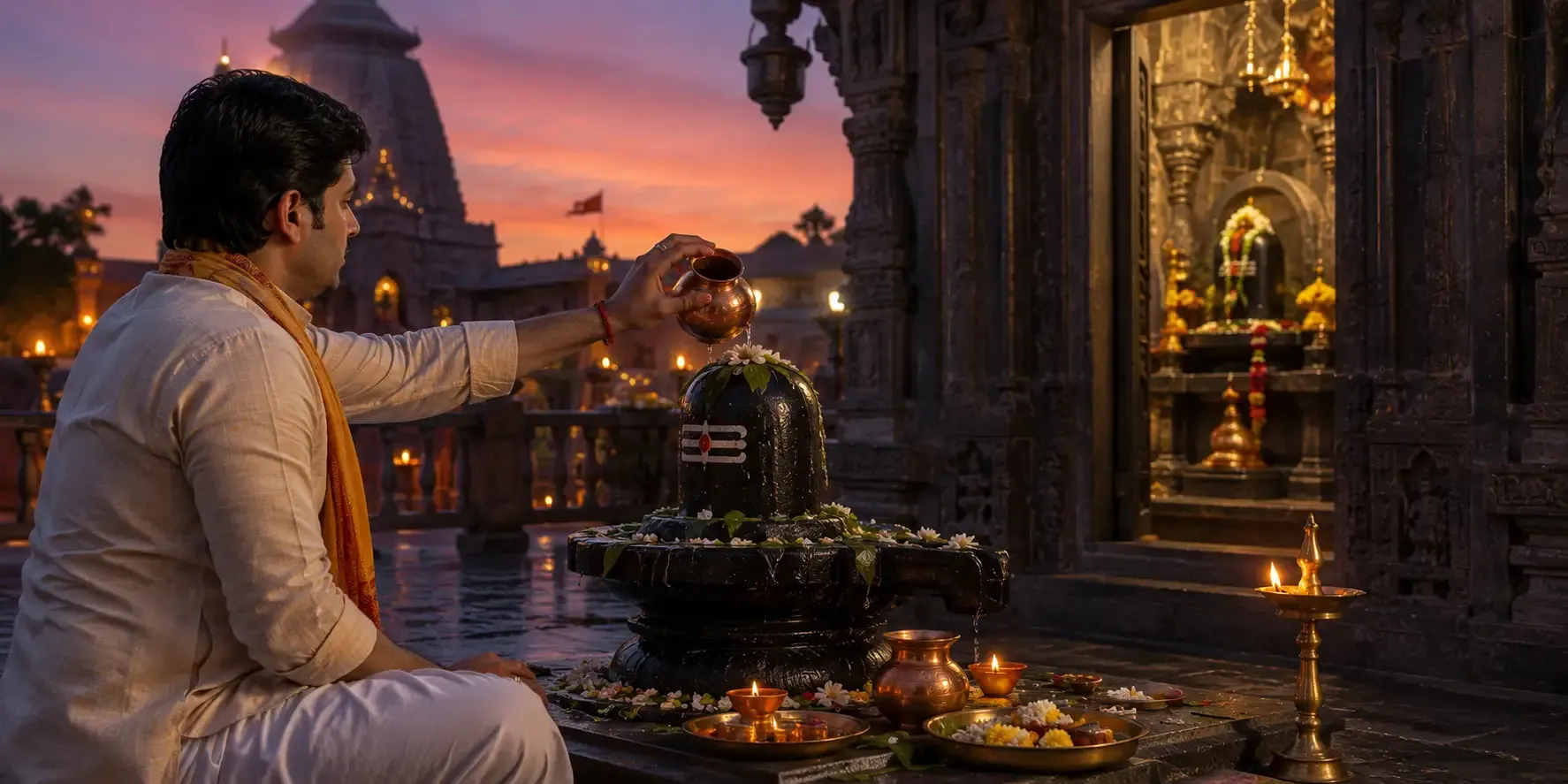
Among all the Pradosh fasts dedicated to Lord Shiva, Som Pradosh Vrat, observed when Pradosh falls on a Monday, is considered especially auspicious. Devotees believe that worshipping Lord Shiva during this sacred period helps remove difficulties, brings peace to the mind, and fulfills sincere desires.
Som Pradosh Vrat Katha
According to the Skanda Purana, Suta Ji narrated this sacred story to the assembled sages.
Long ago, there was a prosperous kingdom known as Vidarbha. Its king was righteous and compassionate. He ruled his people with fairness and ensured that justice prevailed throughout the land. Under his care, the kingdom flourished, and its people lived peacefully.
But time does not remain the same forever.
One day, several neighboring rulers joined forces and attacked Vidarbha. A fierce battle followed. Brave warriors from both sides fought with unmatched courage, but fate had already written its verdict. In the end, the King of Vidarbha was killed on the battlefield.
Back in the palace, the queen received the devastating news.
She was carrying the king's child.
Overwhelmed with grief and fearing for the safety of her unborn baby, she quietly left the palace under the cover of darkness and made her way into the forest.
By dawn, exhausted from sorrow and hardship, she reached the banks of a lake. Beneath the shade of a tree, she gave birth to a baby boy.
For a brief moment, it seemed as though destiny had shown her mercy.
But before she could gather herself, thirst overtook her. Leaving the newborn beneath the tree, she walked towards the lake to drink water.
What happened next changed the child's life forever.
A crocodile lurking in the water suddenly attacked and dragged the helpless queen away.
The infant prince had entered the world only to lose both his parents within moments of his birth.
Wrapped in silence and uncertainty, the child lay beneath the tree, crying.
Uma Brahmani Finds the Child
At that very time, by Lord Shiva's divine will, a poor widow named Uma Brahmani happened to pass through the forest.
She survived by begging for alms and was carrying her own one-year-old son, Shuchivrata, in her arms.
Hearing the desperate cries of the infant, she stopped.
"Who could leave such a tiny child all alone in this wilderness?" she wondered.
As she stood there trying to understand what had happened, a radiant ascetic appeared before her. His serene face and extraordinary presence made him seem no different from Lord Shiva Himself.
Looking at Uma Brahmani, he said,
"Take this child with you and protect him. Raising him will bring you great merit and blessings."
Before she could ask anything further, the ascetic disappeared.
Uma Brahmani accepted his words as divine instruction.
Without hesitation, she lifted the child into her arms and brought him home.
She raised him with the same affection she gave her own son.
The orphaned prince came to be known as Dharmagupta.
Sandilya Muni Reveals the Truth
Years passed.
Though poor, Uma Brahmani raised both boys with honesty and compassion.
One day, while seeking alms, she took them to a temple where the revered Sandilya Muni had arrived.
After offering her respects, she folded her hands and said,
"Revered sage, many years ago, I found this child abandoned in the forest. A holy ascetic instructed me to raise him, but I still do not know whose son he is. Kindly tell me who he truly is."
Closing his eyes in meditation, Sandilya Muni perceived the truth through divine insight.
When he opened them, he said,
"This child is no ordinary boy. He is the son of the late King of Vidarbha."
He then narrated the entire sequence of events—the king's death in battle, the queen's tragic end, and how the child had been left orphaned.
Uma Brahmani listened in astonishment.
But another question troubled her heart.
"If he is truly a prince, why does he live in poverty? Why has destiny brought him here? And how will he ever regain what he has lost?"
The Consequences of Past Actions
Sandilya Muni gently explained that the joys and sorrows experienced in this life often have roots deeper than the present birth.
He revealed that in his previous life, Dharmagupta's father had been the ruler of the Pandya kingdom.
One evening during Pradosh Kaal, the king had been worshipping Lord Shiva with devotion.
Just then, disturbing news arrived—an enemy had been captured.
Unable to restrain his anger, the king abandoned the worship midway. He ordered the enemy's execution and, without completing the sacred observance properly, sat down to eat.
The sanctity of Pradosh worship had been broken.
As a result of that lapse, he was reborn as the King of Vidarbha and lost his life before fully enjoying the prosperity destined for him.
Sandilya Muni then looked at Dharmagupta.
"Even this prince bears the consequences of past actions."
In a previous birth, Dharmagupta too had neglected Lord Shiva's worship during Pradosh and eaten without observing the proper discipline.
That mistake had followed him into this life.
Although born into royalty, he had been destined to experience hardship and poverty.
The sage further explained that the queen's untimely death was linked to a grave sin committed in an earlier birth.
Even Shuchivrata's poverty had karmic roots. Though born as a Brahmin previously, he had neglected righteous duties and lived only for personal survival.
Uma Brahmani fell silent.
It seemed that every sorrow had a reason.
Yet Sandilya Muni did not leave them in despair.
He said,
"No destiny is beyond the reach of devotion. The sincere worship of Lord Shiva during Pradosh has the power to soften even the harshest consequences of karma."
He advised both boys to observe Pradosh Vrat faithfully and worship Lord Shiva with unwavering devotion.
"Do this with sincerity," he said, "and within a year, your hardships shall begin to fade."
The Test of Character
Following the sage's instructions, Dharmagupta and Shuchivrata devoted themselves wholeheartedly to Lord Shiva.
Months passed.
One day, while bathing in a river, Shuchivrata discovered a pot filled with treasure hidden beneath the water.
Excited, he brought it home and said that the wealth should be divided equally between him and Dharmagupta.
But the prince quietly shook his head.
"I cannot claim what destiny has not given me," he said. "Every person must experience the fruits of his own deeds."
Even in poverty, Dharmagupta refused to abandon righteousness.
The Arrival of Anshumati
Some time later, the two boys ventured into the forest.
There they came upon a group of Gandharva maidens engaged in play.
Sensing that they should not intrude, Shuchivrata wished to turn back.
But Dharmagupta moved ahead without fear.
Among the maidens was Anshumati, daughter of a Gandharva king.
As she spoke with Dharmagupta and learned of the losses he had endured without bitterness or complaint, admiration slowly gave way to affection.
Before parting, she asked him to return after two days.
When Dharmagupta arrived again, he found Anshumati standing beside her father.
The Gandharva king welcomed him warmly and revealed a divine message.
"I recently visited Mount Kailash," he said. "There, Lord Shiva and Goddess Parvati instructed me to give my daughter Anshumati's hand in marriage to you and help you reclaim your rightful kingdom."
Dharmagupta was overwhelmed.
By Lord Shiva's grace, he married Anshumati.
The Gandharva king then provided him with a powerful army.
With their support, Dharmagupta defeated his enemies and regained the kingdom of Vidarbha.
The Blessings of Som Pradosh Vrat
Once restored to the throne, Dharmagupta never forgot those who had stood beside him during his darkest days.
He honored Uma Brahmani—the woman who had raised him when he had nothing—by granting her the dignity and respect of a queen mother.
He embraced Shuchivrata not merely as a companion but as his own younger brother.
The prince who had once depended on alms now ruled with wisdom, humility, and compassion.
Suta Ji concluded by saying that through the observance of Pradosh Vrat and sincere devotion to Lord Shiva, Uma Brahmani, Shuchivrata, and King Dharmagupta overcame suffering and attained prosperity, honor, and happiness.
This sacred katha reminds devotees that difficult times do not last forever. Mistakes of the past may shape one's journey, but devotion, repentance, and unwavering faith have the power to transform destiny itself.
Those who listen to or recite the Som Pradosh Vrat Katha with a sincere heart are blessed by Lord Shiva's grace and guided toward a life filled with peace, strength, and hope.
Har Har Mahadev.
Frequently Asked Questions
Common queries about observing Som Pradosh Katha correctly.
What is the significance of Som Pradosh Vrat?
Som Pradosh Vrat is considered highly auspicious because it falls on a Monday, a day dedicated to Lord Shiva. Devotees believe that observing this vrat brings Lord Shiva's blessings and removes obstacles from life.
What are the benefits of Som Pradosh Vrat?
Som Pradosh Vrat is believed to bring peace, prosperity, success, good health, and relief from hardships. Many devotees also observe it for wish fulfillment and family well-being.
Can unmarried girls observe Som Pradosh Vrat?
Yes, unmarried girls can observe Som Pradosh Vrat. It is believed that worshipping Lord Shiva with devotion helps in seeking a suitable life partner and marital happiness.
Can Som Pradosh Vrat help fulfill wishes?
According to Hindu beliefs, sincere observance of Som Pradosh Vrat and listening to the katha can help devotees receive Lord Shiva's blessings for their heartfelt desires.
Is listening to Som Pradosh Vrat Katha necessary?
Yes, reading or listening to the Som Pradosh Vrat Katha is considered an important part of the vrat, as it highlights the power of devotion and the significance of Lord Shiva's grace.
Which deity is worshipped during Som Pradosh Vrat?
Lord Shiva is the principal deity worshipped during Som Pradosh Vrat. Goddess Parvati is also worshipped for happiness, harmony, and prosperity.
Can women keep Som Pradosh Vrat?
Yes, women of all ages can observe Som Pradosh Vrat for family welfare, marital bliss, prosperity, and spiritual growth.
What does Som Pradosh Vrat Katha teach devotees?
The katha teaches that sincere devotion, righteous conduct, and faith in Lord Shiva can help overcome difficulties and change the course of one's destiny.
॥ ॐ ॥